From Ancient Alchemy to Modern Possibilities
Written by Junes Sami Bakkar · Co-Founder of Receive Harmony
For thousands of years, humanity has been fascinated by transformation — and by the possibility of transmutation.
Can one substance become another? Can what is ordinary become extraordinary? Can something heavy, imperfect or unfinished be refined into something precious?
Few traditions have explored these questions as vividly as alchemy.
Today, alchemy is often reduced to one famous image: an alchemist attempting to transform lead into gold. Yet behind this image lies a much richer history — one that stretches from the workshops and philosophical traditions of Greco-Roman Egypt through the Arabic world and into medieval and early modern Europe.
Alchemy was concerned with matter, but its language of transformation and transmutation would eventually reach far beyond matter.
And perhaps that is why it still speaks to us today.
Chapter I · Greco-Roman Egypt
From Egypt to the Art of Alchemy
Some of the earliest substantial writings that we recognize as alchemical emerged in Greco-Roman Egypt.
Around 300 CE, the Greco-Egyptian alchemist Zosimos of Panopolis, born in what is now Akhmim in Upper Egypt, wrote extensively about alchemical practices, apparatus and furnaces. His surviving writings belong to a world in which practical craft knowledge — including work with metals, minerals and other substances — met philosophical ideas about the nature of matter.
This was not simply fantasy.
Alchemy involved experiments, recipes, furnaces, distillation, coloration, metallurgy and attempts to understand how substances could be changed. Gold-making — known as chrysopoeia — became one of its most famous ambitions.
The central dream was extraordinary:
“If matter can change, how far can transformation — and transmutation — go?”
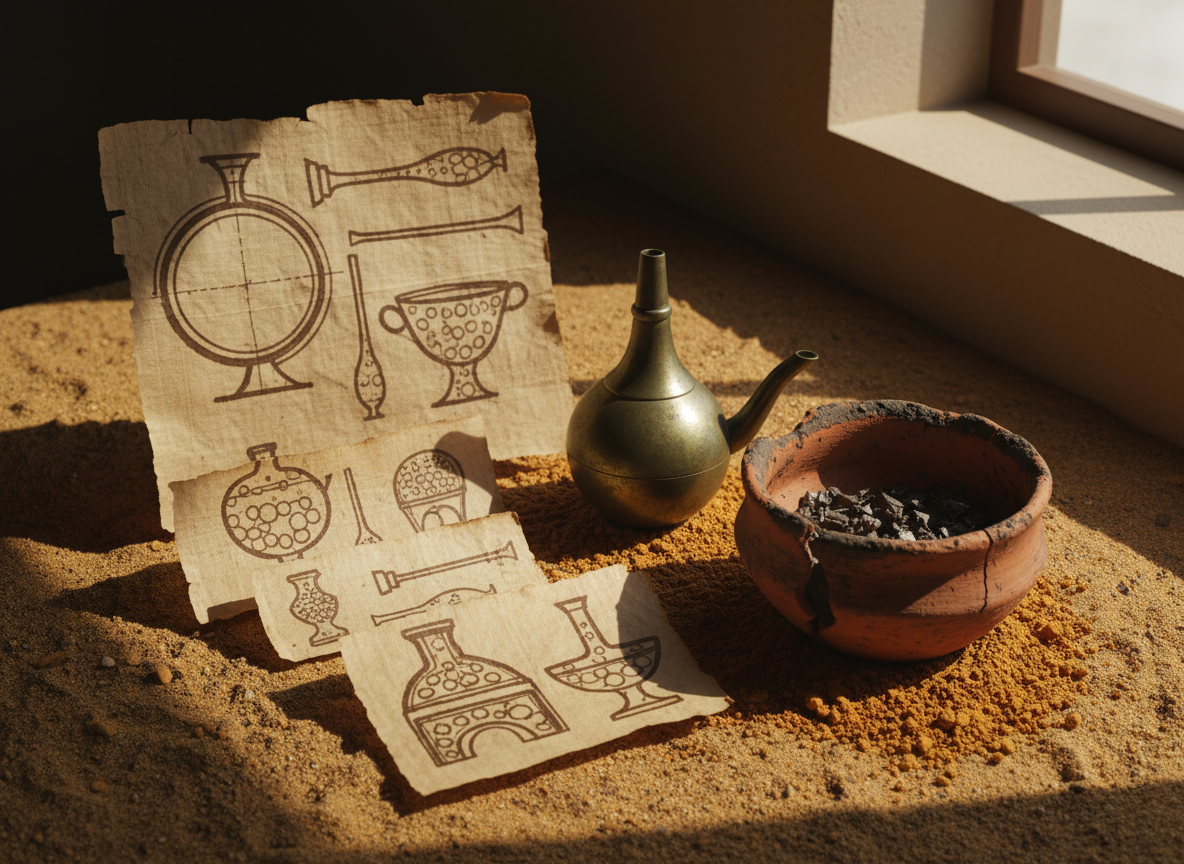
From Greek chrysos (gold) and poiein (to make) — the art of making gold.
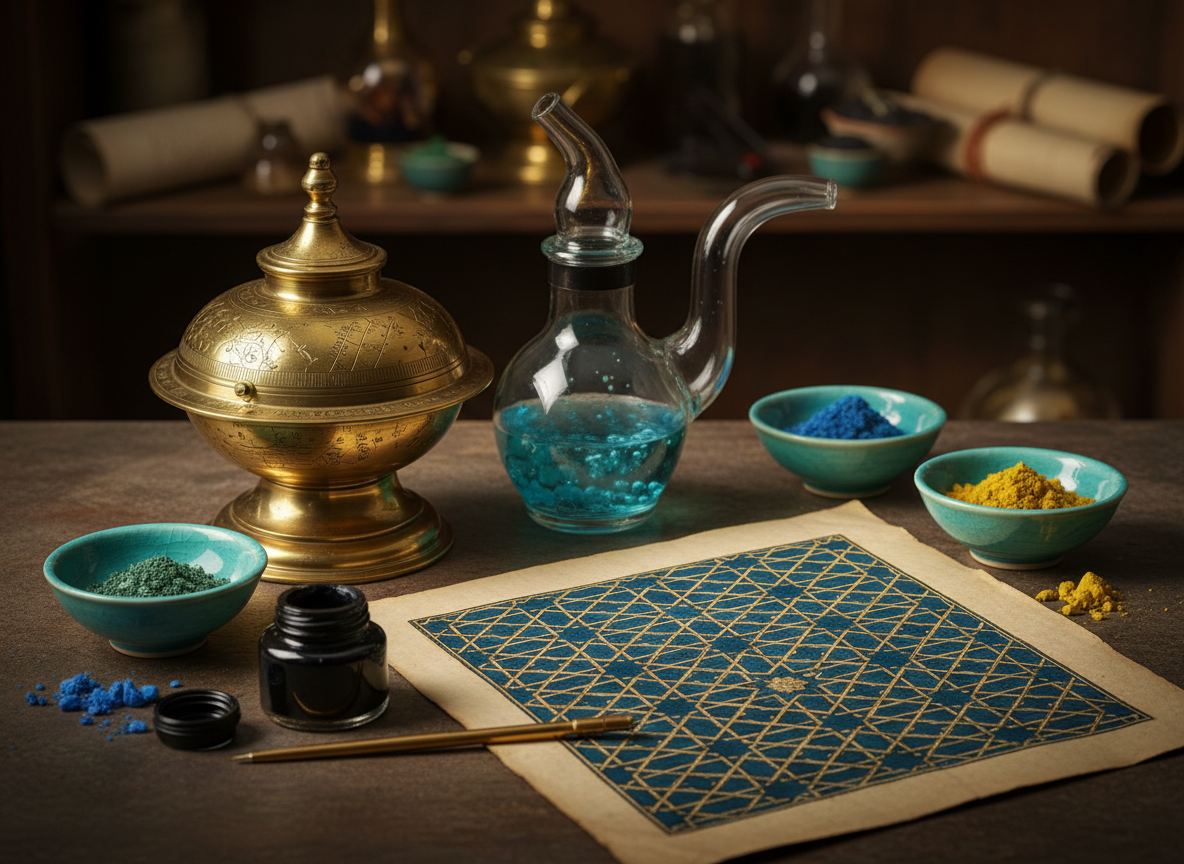
Papyrus, vessel & crucible · the workshop of matter
Knowledge travels
- Greco-Roman Egypt c. 300 CE
- The Arabic-speaking world From the 8th century
- Medieval Europe Toward chemistry
From Arabic al-kīmiyāʾ, itself likely drawn from the Greek chēmeia.
From Arabic al-iksīr, from the Greek xērion — a dry, healing powder.
From Arabic al-anbīq, from the Greek ambix — a distilling vessel.
Astrolabe, alembic & geometry
Chapter II · The Arabic world
Al-Kīmiyāʾ — Knowledge Travels and Transforms
Alchemy itself did not remain in one culture.
Knowledge from Hellenistic Egypt was absorbed, translated and transformed within the Arabic-speaking world. From roughly the eighth century onward, Arabic scholars developed extensive alchemical traditions of their own, including writings associated with Jābir ibn Ḥayyān and al-Rāzī.
Arabic alchemy contributed significantly to practical laboratory culture and helped transmit earlier knowledge into medieval Europe. Its vocabulary also left a lasting imprint: words including alchemy, elixir and alembic entered European languages through Arabic.
Alchemy was therefore itself undergoing a kind of transmutation.
Ideas crossed cultures. Techniques changed. Philosophies combined. New possibilities emerged from older knowledge.
Centuries later, European alchemy would intertwine laboratory practice with medicine, natural philosophy, religion and symbolism. Some of its experimental practices became part of the complex historical development that eventually contributed to modern chemistry.
Yet the image that survived most powerfully was still remarkably simple:
Lead into gold.
Chapter III · Pb → Au
Why Lead? Why Gold?
Lead is dense. Heavy. Dark.
It is, quite literally, a heavy metal.
Gold appears almost as its symbolic opposite: brilliant, precious, resistant to corrosion and historically associated with wealth, perfection and the Sun.
For alchemists, the transmutation of base metals into gold represented an extraordinary possibility: that matter itself could be refined and fundamentally changed. Historical alchemy should not simply be rewritten as psychology; much of it involved genuine material experimentation and theories about physical substances.
But over time, alchemical transformation also became a powerful religious, philosophical and eventually psychological metaphor. Early modern writers could use the transformation of base metals into gold as an image of spiritual transformation, while centuries later Carl Jung famously explored alchemical imagery in relation to psychological integration and transformation.
That opens another possibility.
“What happens when we turn the alchemical laboratory inward?”
Chapter IV · Turning inward
The Inner Laboratory
We all carry our own forms of heaviness.
Old conditioning. Fear. Limiting beliefs. Defensive patterns. Unprocessed experiences. Identities we inherited rather than consciously chose.
In modern metaphysical language, we might associate some of these structures with the ego — not as an enemy that needs to be destroyed, but as material that can be observed, understood and transformed.
In that sense, lead becomes a powerful metaphor.
“Lead is a heavy metal — and human beings can carry heavy structures too.”
Inner alchemy does not require us to reject those structures or pretend that difficult experiences never happened. Transformation can begin by bringing them into awareness.
The goal is not destruction.
It is transmutation.
- Fear can become understanding.
- Experience can become wisdom.
- Limitation can become possibility.
- Fragmentation can move toward integration.
And slowly, what was once experienced as inner weight can reveal something more refined.
Chapter V · Refinement
Finding the Gold
What, then, is the gold?
Different traditions use different language.
- The True Self.
- The Higher Self.
- The authentic self.
- Inner wisdom.
- Consciousness.
- Simply becoming more fully who we are.
The name matters less than the process.
Gold does not need to symbolize perfection. Human transformation does not mean reaching a flawless final state in which nothing difficult ever arises again.
Instead, gold can represent what becomes visible when we refine how we relate to ourselves and our experiences.
Perhaps the purpose of inner alchemy is not to manufacture something artificial.
Perhaps it is to uncover what was valuable all along.
Chapter VI · Between worlds
The Art of Transformation
This is where the ancient image of alchemy becomes surprisingly contemporary.
We may no longer stand beside medieval furnaces searching for the Philosopher’s Stone, yet transformation and transmutation remain everywhere.
- We transform knowledge into understanding.
- Ideas into creations.
- Experience into wisdom.
- Challenges into new directions.
Separate elements combine and produce possibilities that did not exist before.
And this principle extends beyond the individual.
- Ancient wisdom can meet modern knowledge.
- Tradition can meet innovation.
- Nature can meet technology.
- Science can meet philosophy without either losing its identity.
Transformation does not always require choosing one world over another.
Sometimes it begins by discovering what becomes possible between them.
And perhaps this is another meaning hidden within the language of alchemy: it asks us not only to explore matter, but to reconsider what matters.
What Matters
What do we choose to refine?
What do we preserve?
What do we transform?
And what are we ready to transmute into something new?
Chapter VII · Our practice
Alchemy at Receive Harmony
At Receive Harmony, we understand alchemy first and foremost as a symbol and practice of transformation, transmutation, combination and possibility.
We remain fascinated by the historical traditions that gave alchemy its extraordinary imagery, while also exploring what transformation can mean in a modern world.
Not every ancient idea needs to be accepted literally to contain inspiration.
Not every modern innovation needs to disconnect us from the knowledge of the past.
- Instead, we can remain curious.
- We can experiment.
- We can learn.
- We can combine.
- We can transform.
- And we can transmute.
Because whether we are working with matter, ideas, habits, creativity, knowledge or the way we understand ourselves, the ancient question remains surprisingly alive:
“What could this become?”
That is the art of transformation.
“Where elements combine, new possibilities align — through transmutation, matter can redefine.”